
Every Later Living Sales and Marketing Director knows the sales cycle is long. You’ve lived with the Later Living sales cycle for years. Prospects take months to decide. House sales stall at the last minute. Completions slip into the next financial year, and the board asks why. You don’t need anyone to explain it.
So this isn’t another article about trigger points and downsizing anxiety. It’s about what you can do about it.
Know your number, and where the time goes
If the sector average from first enquiry to completion is around 36 weeks, what matters is your own number. Where does your cycle spend its time? Is it the weeks before a prospect reserves, or the weeks between reservation and completion? Each needs a different fix.
Jacobs Brain measures cycle time as one of the four pillars of the Sales Velocity Index. It splits the time into two stages, to reservation and to completion, and benchmarks each against UK Later Living averages.
Take one community’s figures for the second quarter of 2026. Its cycle time was 37.3 weeks against a 36-week average. That split into 18.3 weeks to reservation and 19 weeks to completion, each just behind the benchmark. A week here and a week there doesn’t sound much. But it can push a completion into the next financial year.
But the bigger story came earlier in the journey. The community had no shortage of interest. It recorded 108 first visits in the quarter, against an industry average of 47. Yet only 6.1% of those visits turned into reservations, against a benchmark of 14.1%. Jacob sized the gap at roughly 11 extra reservations over three months. Slow conversion also feeds a slow cycle. Prospects who leave without a second visit booked let their interest cool. They hand the decision to family, and the weeks start to stretch.
See whether you’re speeding up or slowing down
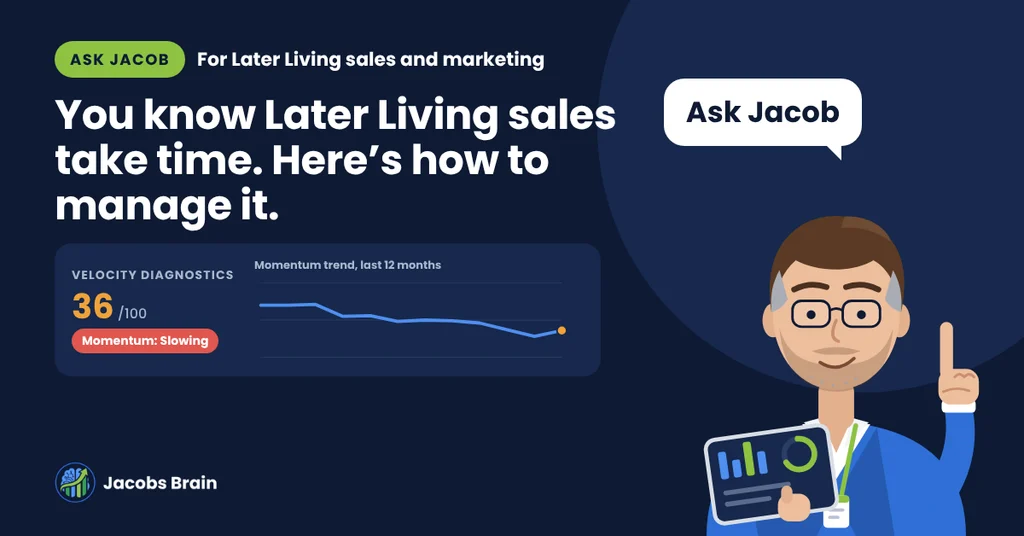
A single quarter tells you where you are. It doesn’t tell you which way you’re heading. That’s why Jacobs Brain now includes Velocity Diagnostics. This new page turns each community’s monthly figures into a clear story about sales momentum.
- One Velocity score from 0 to 100, with a plain-English band and the change since last month.
- A momentum signal of Accelerating, Steady or Slowing, comparing your latest three months with the three before.
- Four pillar cards for Pipeline Volume, Conversion, Deal Quality and Cycle Time, each with its own score, change and momentum.
- A 12-month trend chart and a month-versus-month comparison, so turning points stand out at a glance.
It matters because a good month can hide a slowing trend. In the same community, the Velocity score rose 8 points in October. Yet the momentum signal still read Slowing, because the last three months were weaker than the three before. Without the trend, that rise would have looked like recovery.
Velocity Diagnostics doesn’t stop at naming the weak link. Ask Jacob why, and he explains each lagging pillar. He sets out the evidence and the most likely real-world cause in UK Later Living. He shows how that cause slows sales, and gives your team one quick check for this week. His Anomaly Check allows for anything unusual, such as a month-end event or a staffing gap. That keeps the analysis fair. Velocity Diagnostics fills in automatically from the monthly data you already enter, with no set-up.
Plan for the lag, rather than hoping it won’t happen
You know that late-year enquiries rarely complete in the same year. The risk is a plan that assumes they will. Jacobs Brain’s Budget Realism Stress Tester checks for funnel time-lag. It flags enquiries that are unlikely to complete inside the plan year. It also applies your community’s own cancellation rate.
In one example, a plan assumed 91.4% of reservations would complete. Once Jacobs Brain applied real leakage, the plan delivered roughly 8.5 sales against a target of 10.3. Far better to know that before the board signs off the budget than to explain it in the summer.
Five ways to shorten the Later Living sales cycle
- Find the trigger, then book the second visit. Use the first visit to understand why this prospect is thinking of moving now. Make sure nobody leaves without a second visit in the diary. Aim for at least 70% of first visits to end that way. Then shape every follow-up around the prospect’s own reason for moving.
- Take the house sale off the critical path. Explain part exchange or assisted move support within the first 15 minutes of a first visit. That stops the sale of the family home becoming the reason to wait. Some operators now go further and offer a rental option. Prospects can then move in straight away and sell their home in their own time. They no longer face the stress of waiting for a buyer first.
- Get the legal side moving early. Send a legal FAQ pack with every brochure request and first-visit confirmation. Include a panel of solicitors who know Later Living leasehold. Aim for buyers to instruct a solicitor within two weeks of reservation.
- Chase the chain every week. Check every reservation weekly for part-exchange progress, probate and whether the onward chain is ready. That way you spot delays while you still have time to act.
- Watch the market around you. Site and Context Analysis scores local housing market liquidity. You spot a sluggish market before it stalls your pipeline, and you can put support in place sooner.
Manage what you can control
You cannot make the decision for your prospects. But you can know exactly how long your cycle is. You can plan honestly around it and remove the obstacles that slow it down.
UK and Ireland support for Jacobs Brain through Lead Intuition
Jacobs Brain is available across the UK and Ireland through Lead Intuition, its exclusive distribution partner. Lead Intuition provides onboarding, training and ongoing support. Its team understands the specific demands of Later Living sales and marketing. Want to benchmark cycle time for one community, or plan a rollout across several developments? They will help you get there.
Ask Jacob
How long is your sales cycle really, and is it costing you completions? Book a demo at jacobsbrain.ai or call 01603 249955 to see your cycle time against the sector. Then Jacob will tell you exactly where you’re losing weeks and which completions could slip into next year. He’ll also show you which actions will bring them forward. Just Ask Jacob.