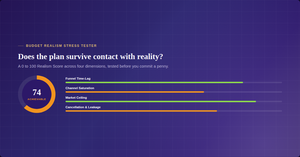
As the third quarter draws to a close, later living operators face the familiar ritual of annual budget planning. Marketing and sales leaders pull up financial workbooks to model the spend required to hit ambitious occupancy targets.
A standard spreadsheet easily calculates how many enquiries, site tours, and reservations are needed to move an asset from 82% to 92% occupancy. However, traditional spreadsheets operate on static math rather than operational reality. They routinely hide structural flaws that leave executive teams vulnerable to end-of-year shortfalls.
Transforming an optimistic sales target into a stress-tested, deliverable plan requires moving beyond static modeling and adding stress testing.
| Budget Approach | Traditional Static Approach | Stress-Tested Realism Engine |
| Lead-Lag Accounting | Assumes late-year enquiries complete in-year | Maps lead-lag cycles against the CRM pipeline |
| Channel Scaling | Assumes linear lead growth without cost hikes | Flags channel saturation and rising Cost Per Enquiry |
| Demographic Sanity | Ignores local market population limits | Benchmarks targets against qualified local catchment |
| Attrition Handling | Treats reservations as guaranteed completions | Factor-in community-specific cancellation rates |
| Actionability | Requires manual formula tweaks | Generates a 0–100 Realism Score with 1-click fixes |
The Four Flaws Hidden in Standard Senior Living Budgets
Traditional budgeting models often rely on best-case scenarios that fail to survive contact with the market. When operators stress-test their draft plans, four primary structural risks routinely emerge:
1. The Lead-Lag Timeline Trap
The sales cycle in UK later living is naturally extended. The journey from initial enquiry to tour, reservation, and legal completion frequently spans several months.
If a community’s average sales cycle is 36 weeks, an enquiry generated in October cannot legally complete before 31 December. Static spreadsheets regularly credit Q4 marketing campaigns with in-year completion revenue. In reality, the completions required to hit next year’s targets must already exist within the CRM funnel today.
2. Theoretical Channel Scaling
Marketing channels rarely scale in a straight line. Doubling or tripling the budget on digital search or localised print advertising does not automatically yield double or triple the qualified enquiries.
As search volume caps out in a specific geographic radius, acquisition costs rise sharply. Budgets that assume historic Cost Per Enquiry (CPE) rates while drastically increasing volume targets overlook channel saturation.
3. Local Catchment Ceilings
Every senior living asset relies on a defined geographic catchment. An aggressive growth strategy is only viable if the qualified over-65 population within that radius can support the required lead volume.
When draft budgets demand an unnaturally high market penetration rate from the immediate area, the plan relies on statistical optimism rather than local demographic reality.
4. Unadjusted Funnel Leakage
A reservation is not a completed sale. Subject to chain delays, health changes, and market fluctuations, reservation fall-throughs are an inevitable operational metric.
Budget frameworks that fail to deduct historical cancellation rates create an immediate revenue deficit. To hit net occupancy targets, the gross top-of-funnel volume must be scaled to absorb expected leakage.
Stress-Testing Plans with the Budget Realism & Feasibility Engine
To eliminate reliance on gut feel during budget sign-offs, Jacobs Brain has launched the Budget Realism & Feasibility Engine within our Budget Builder platform.
Instead of leaving operators to manually sense-check complex workbooks, the engine automatically calculates the required sales velocity backwards from target occupancy, then stress-tests the draft across four operational dimensions:
Diagnostic Intelligence & Single-Click Adjustments
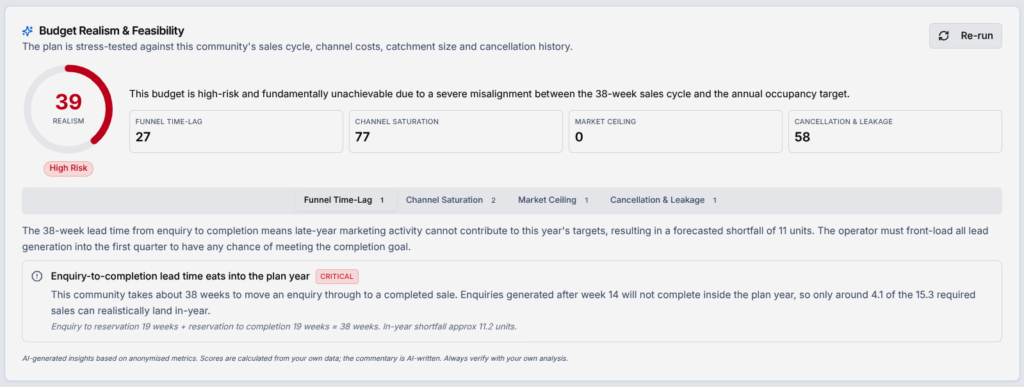
Rather than functioning as an opaque system, the engine delivers transparent, empirical diagnostics:
- Realism Score (0–100): Consolidates pipeline feasibility into an executive score categorised as Achievable, Moderate Risk, or High Risk.
- Evidence-Based Findings: Clear findings highlight whether risk flags stem from the community’s historical tracking or established UK sector benchmarks.
- One-Click Corrections: Integrated severity chips offer an ‘Apply Fix’ feature, instantly updating draft parameters with realistic values.
Upgrading Boardroom & Governance Conversations
Moving from static spreadsheets to dynamic stress-testing changes how senior living leadership evaluates growth strategies
- For Community Managers: Replaces unrealistic end-of-year quotas with achievable, monthly milestone targets.
- For Regional Directors: Enables standardised risk scoring across multiple sites to allocate marketing capital efficiently.
- For Boards & Investors: Provides empirical confidence that target occupancy trajectories are grounded in market reality, catchment data, and historical sales velocity.
Budgeting should not be an exercise in showing leadership what they hope to see. By stress-testing assumptions before signing off on annual plans, later living operators protect their margin, optimise lead acquisition, and ensure target occupancy is built on reality.
If you would like to see budget stress testing in action, scheduled a demo of Jacobs Brain