Every year, the same scene plays out in boardrooms across the Later Living sector. A marketing director presents a carefully assembled budget, the finance director asks where the numbers came from, and the answer is some version of “industry benchmarks and past experience.” The budget gets trimmed, the targets stay the same, and the team spends the next twelve months trying to hit occupancy goals with a plan that was undermined before it started.
The problem is not the marketing director’s competence. It is the gap between what boards now expect and what spreadsheet budgets can prove. In 2027, Later Living operators will face rising build costs, longer sales cycles and tighter margins. Boards are no longer satisfied with budgets built on estimates. They want evidence.
Jacobs Brain’s Marketing Budget Builder closes that gap. It does not start from benchmarks or last year’s spend. It starts from the performance data your Jacobs Brain platform already holds, works backward from your occupancy target, and produces a budget that can answer every question a board is likely to ask.
The credibility gap: why estimate-based budgets fail under challenge
A Later Living marketing budget faces scrutiny that most sectors never encounter. The sales cycle can stretch beyond twelve months. A single unit sale can be worth hundreds of thousands of pounds in lifetime revenue. And the audience, older adults and their families making one of the most significant decisions of their lives, does not respond to volume-driven tactics the way other markets do.
Yet most marketing budgets in the sector are still built the same way they were a decade ago: a spreadsheet, a set of assumptions about cost per lead, a percentage-of-revenue rule borrowed from a conference slide, and a hope that the numbers hold up when challenged.
They rarely do. Here is what typically breaks down:
- The assumptions are unverifiable. When a board member asks why the cost-per-enquiry figure is what it is, the honest answer is often “that is what we spent last year.” There is no connection to actual conversion data, no adjustment for channel performance, and no accounting for the difference between an enquiry and a move-in.
- The sales cycle is invisible. A budget that allocates spend by calendar quarter ignores the reality that an enquiry generated in January may not convert until the following autumn. Without time-lag data, the budget cannot account for the lag between investment and return.
- There is no stress test. The plan is presented as a single scenario. If the board asks “what happens if conversions drop by 15 per cent,” there is no modelled answer. the marketing director is left justifying a budget that has never been tested against anything but optimism.
The evidence is already in the platform
The Budget Builder does not ask you to import data from a dozen sources or build a model from scratch. If you are already using Jacobs Brain, the evidence your budget needs is sitting in the platform right now.
Four connected modules feed directly into the Budget Builder:
- Marketing ROI tracks cost per enquiry, cost per move-in and return on spend across every channel, from paid search and social media to events, direct mail and PR. The Budget Builder pulls actual channel performance rather than estimated averages.
- Sales Velocity Index scores your pipeline health out of 100, combining pipeline volume, conversion rates and sales cycle length into a single, auditable figure. Your budget is built on how your pipeline actually performs, not how you hope it will.
- Site and Context Analysis benchmarks each development location against neighbourhood quality, demographics, housing market conditions, points of interest and competitive density. The Budget Builder factors in the reality that not every site converts at the same rate.
- Enquiry and Sales Tracking provides the conversion funnel data, from first enquiry through to move-in, that underpins every allocation decision.
The result is a budget whose every line can be traced back to a data point the platform has already recorded. When the board asks where a number came from, the answer is not an estimate. It is a link to the evidence.
Four steps from occupancy target to justifiable plan
Traditional budgets start with last year’s spend and adjust upward. The Budget Builder starts with the only number that actually matters: your occupancy target.
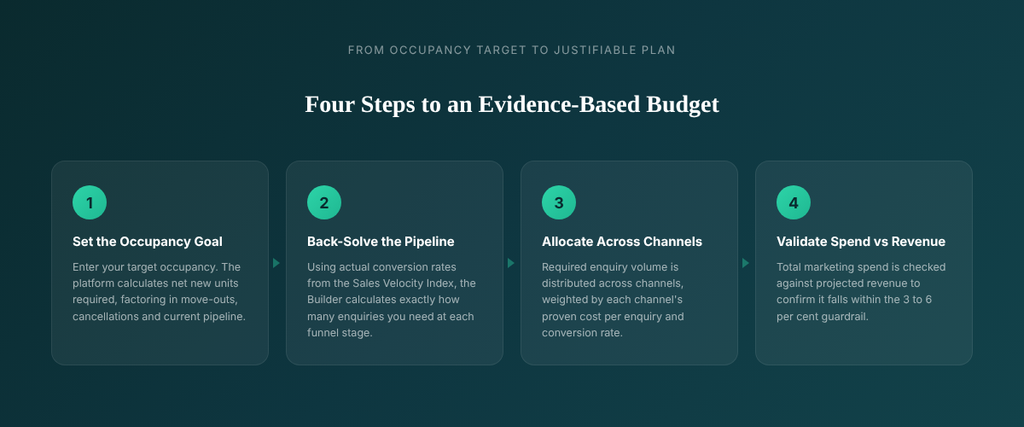
- Set the occupancy goal. Enter your target occupancy for each development. The platform calculates the net new units required, factoring in projected move-outs, cancellations and the current pipeline.
- Back-solve the pipeline. Using your actual conversion rates from the Sales Velocity Index, the Budget Builder works out exactly how many enquiries you need to generate, and at what stage of the funnel, to hit that occupancy number.
- Allocate across channels. The platform distributes the required enquiry volume across your active marketing channels, weighted by each channel’s proven cost per enquiry and conversion rate from the Marketing ROI module. No guesswork about which channels deserve more spend. The data decides.
- Validate spend against revenue. The total marketing spend is checked against projected revenue to confirm it falls within a justifiable range, typically the 3 to 6 per cent guardrail that Later Living operators work within. If it does not, the platform flags the variance before the budget leaves your desk.
The output is not a spreadsheet of hopes. It is a costed plan where every figure connects to a measurable input, and every input connects to the occupancy target the board has already approved.
Stress tested before the board sees it
Building a justifiable budget is one thing. Proving it can withstand real-world pressure is another. That is why the Budget Builder includes the Budget Realism Stress Tester, which scores your plan from 0 to 100 across four dimensions before you present it.
- Funnel time-lag. Does the budget account for the months between generating an enquiry and completing a move-in? A plan that front-loads spend without modelling the conversion delay will overspend in Q1 and underdeliver in Q4.
- Channel saturation. Is any single channel being asked to deliver more enquiries than its historical data supports? The stress tester flags channels approaching their ceiling before you commit the spend.
- Market ceiling. Given the development’s location, demographics and competitive landscape, is the occupancy target achievable? The Site and Context Analysis feeds directly into this score.
- Cancellation and leakage. Does the budget factor in the reality that not every reservation converts to a move-in? Using your actual cancellation and fall-through rates, the stress tester adjusts the pipeline requirement upward to compensate.
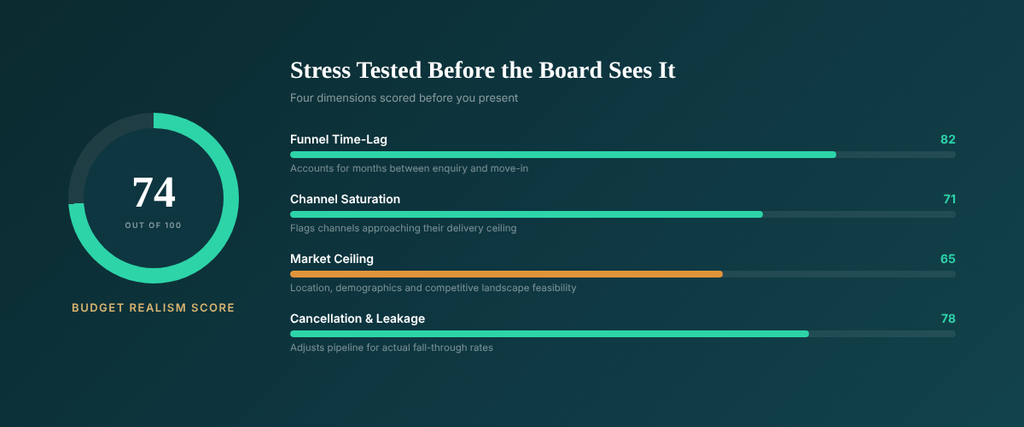
The resulting Realism Score gives you and the board a single, transparent measure of how robust the plan is. A score of 74, for example, tells you the plan is sound but has one or two dimensions that could be strengthened. You can adjust and re-test before anyone outside the marketing team sees it.
No more presenting a plan and hoping nobody asks the hard question. The hard questions have already been asked, and the answers are in the score.
One platform, one source of truth
The Budget Builder is not a standalone tool. It sits inside the Jacobs Brain platform alongside five other modules that serve marketing, sales and senior leadership teams across the Later Living sector.
That integration matters. When your Marketing ROI data updates with new campaign results, the Budget Builder reflects the change. When your Sales Velocity Index shifts because conversion rates improve or drop, the budget assumptions adjust. The plan stays connected to reality throughout the year, not just at the point it was created.
For operators managing multiple developments, this means every site’s budget draws from the same verified data set. There is no reconciliation between spreadsheets, no version-control headaches, and no risk of presenting numbers that contradict what the sales team is reporting.
The board gets a budget built on evidence. The marketing team gets a plan they can justify. And the sales team gets targets that are grounded in the same data they see every day.
UK and Ireland support through Lead Intuition
Jacobs Brain is available in the UK and Ireland through Lead Intuition, its exclusive distribution partner. Lead Intuition provides onboarding, training and ongoing support for operators adopting the platform, with a team that understands the Later Living sector’s particular requirements.
Whether you are building your first evidence-based budget or rolling the platform out across a portfolio of developments, Lead Intuition can guide you through the process.
Book a demo at jacobsbrain.ai or call 01603 249955.